
Materials
What the walls are made of
Almost every rigid container on a shop shelf is one of four or five plastics. They behave differently in heat, in cold and against what is put inside them, and that, more than looks, is what decides which one a container is made from.
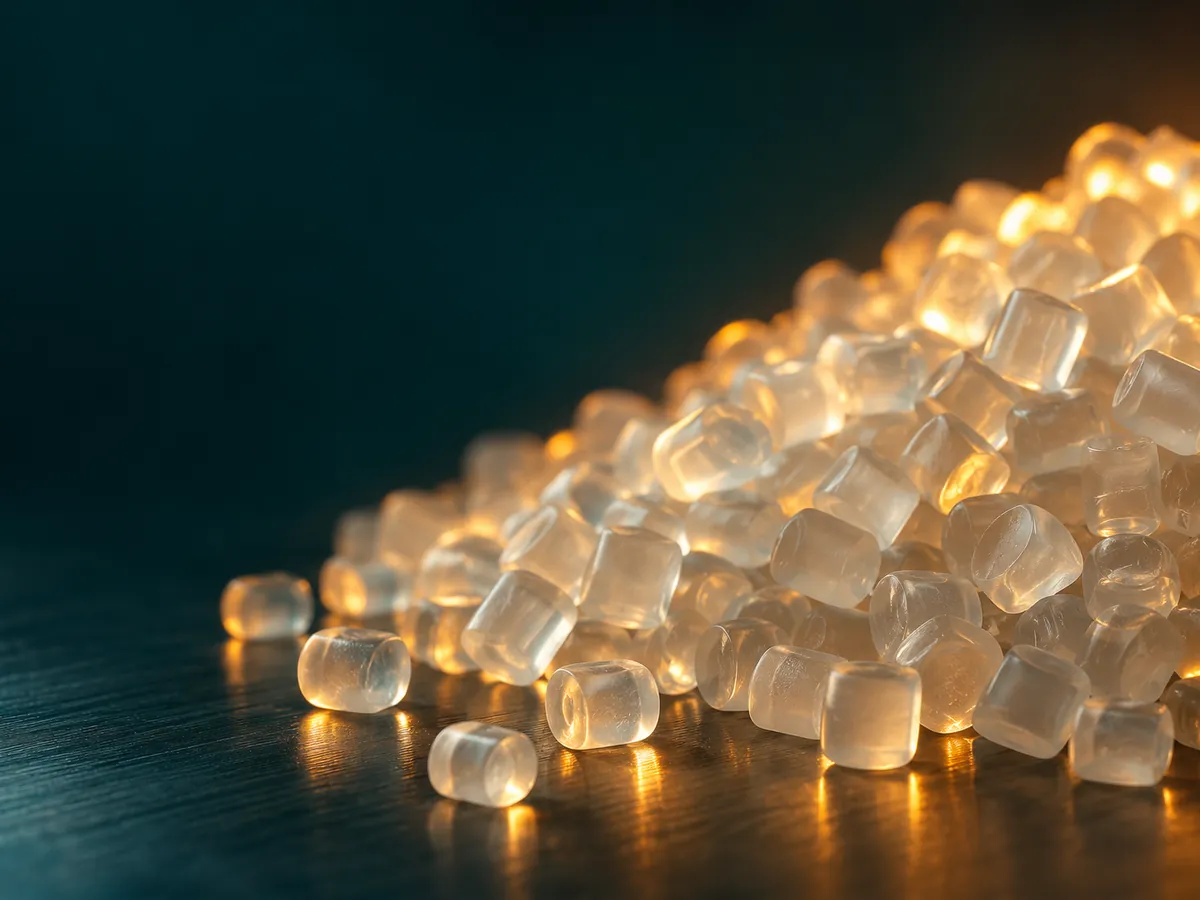
The material is chosen for the product, never the other way round.
Five questions pick the material
What goes inside, and is it oily, acidic, a solvent or a powder? How hot is it when it is filled? Where is the filled container kept — a warm warehouse, a cold store, a freezer? Does the buyer need to see the contents? And will it be thrown away, washed and reused, or collected for recycling?
The answers rarely point to more than one family. A paste filled warm into a container with a snap lid points to polypropylene. A household chemical in a canister that may be dropped in the cold points to high-density polyethylene. A clear jar for dry goods points to PET.
The number on the base
Most plastic packaging carries a resin identification code moulded into the base: a number inside a triangle of arrows. It names the material so the container can be sorted after use. Choose a code below to see what that material is usually asked to do in packaging.
Polypropylene PP · code 5
The usual material for injection-moulded buckets, tubs, food containers, lids and screw caps. It is light and stiff, takes a hinge or a snap fit that is opened many times, and copes with warm filling better than the polyethylenes. Natural PP is milky and translucent.
- Typical shapes
- buckets, tubs, round and square food containers, closures
- Watch for
- it grows brittle in hard frost unless a grade made for the cold is used
High-density polyethylene HDPE · code 2
Tough rather than stiff, and resistant to a wide range of household and industrial chemicals. It stays tough in the cold, which is why it is used for canisters and bottles that may be dropped, and it is usually opaque.
- Typical shapes
- canisters with handles, bottles for cleaning products, buckets for chemicals
- Watch for
- softer than PP for the same wall, so it needs more material to stand up in a stack
Polyethylene terephthalate PET · code 1
Glass-clear and rigid, with a good barrier against gases. Bottles and wide-mouth jars are blown from a small injection-moulded preform, so the shape is set in two stages rather than one.
- Typical shapes
- clear jars for dry goods, bottles for drinks and oils
- Watch for
- ordinary PET softens if filled hot; hot-fill containers need grades and shapes made for it
Low-density polyethylene LDPE · code 4
Soft and flexible. In rigid packaging it appears where something has to give: squeeze bottles, some snap-on lids, and inserts. Most LDPE is used as film rather than as containers.
- Typical shapes
- squeeze bottles, flexible lids, liners
- Watch for
- it will not hold a shape under load on its own
Polystyrene PS · code 6
Rigid and either clear or white. It is easy to thermoform from sheet, which is how many single-portion cups and trays are made, but it is brittle and cracks rather than bends.
- Typical shapes
- portion cups, thin trays, some display packs
- Watch for
- poor resistance to oils and solvents; not a material for a bucket
Colour is added at the press, not bought in
No colourant at all. Translucent PP lets the buyer see the fill level through the wall, which is useful for pastes, honey and anything sold by sight.
The most common choice for buckets of paint, plaster and food. It hides the contents and gives a print or a label an even ground.
Dosed as a masterbatch pellet. A darker or denser colour also shields light-sensitive contents. A brand colour is matched against a sample before a run.
If it will hold food, say so first
A container for food is made from grades whose suppliers declare them suitable for that use, and the declaration states the conditions: the kind of food, the temperature and the time of contact. The colourant has to carry the same kind of declaration. None of this changes the shape of the container, but it can change the material, so it belongs at the top of a brief rather than in the last line.
Tell us what the food is, whether it is filled hot or frozen afterwards, and whether the container will go into a microwave. Those three facts decide the grade; the rest follows. When you are ready, the brief form asks for exactly these.