
Shapes
Buckets, tubs, jars and the sums behind them
Rigid plastic packaging comes in a handful of families. Each one is a compromise between what it holds, how it closes and how it travels empty, and the numbers that matter can be worked out before anyone cuts steel.
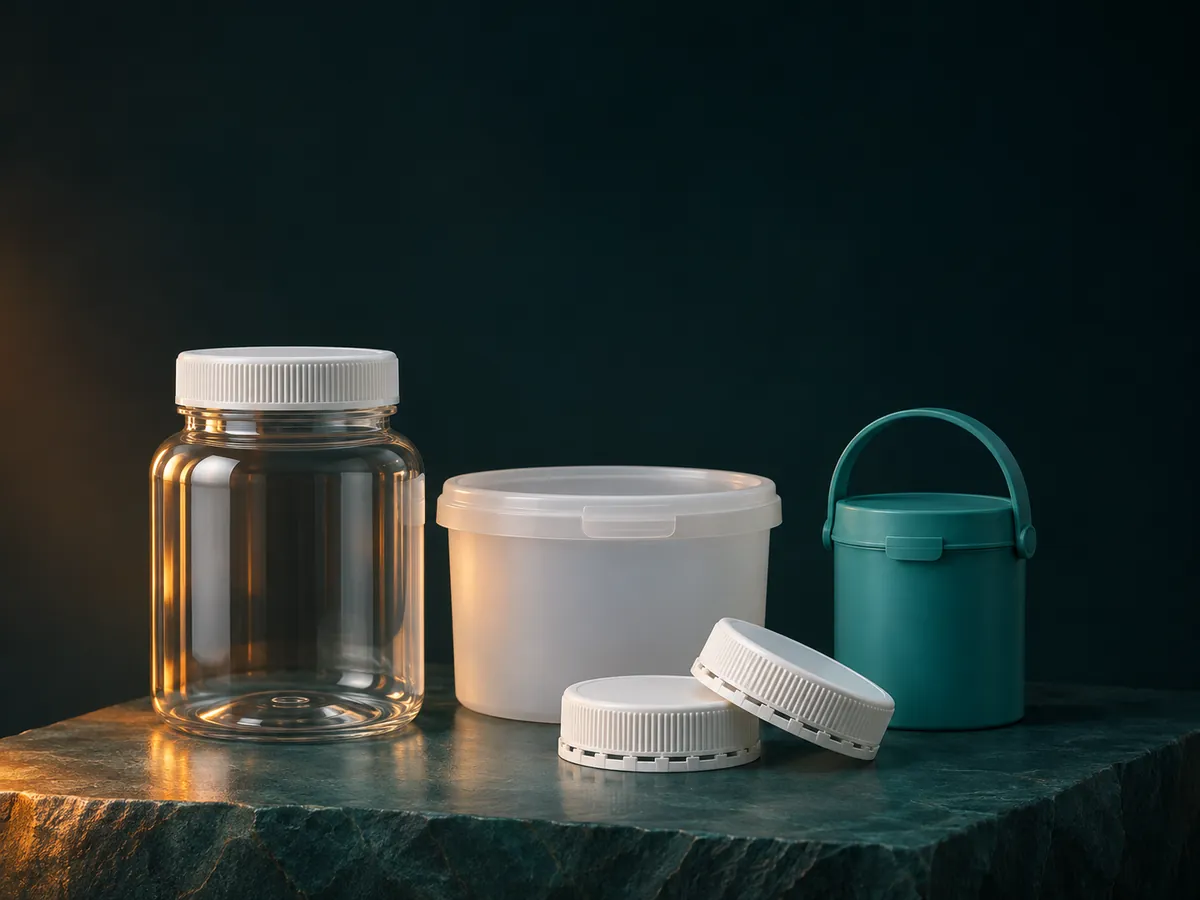
A closure is half the container. A snap lid seals by the rim the mould gives the tub; a screw cap needs a thread on the neck; a tamper-evident band breaks the first time the container is opened, so the buyer can see that it has not been.
Six families of rigid packaging
Buckets and pails
Round, tapered, with lugs for a wire or plastic handle. For paint, plaster, adhesives, food ingredients and anything sold by the litre.
Tubs and food containers
Shallower and lighter, round or square, with a snap lid. Pastes, spreads, salads, ice cream, dairy.
Jars with screw caps
A neck with a thread and a wide mouth. Dry goods, honey, cosmetics, supplements.
Canisters
Usually blow-moulded, with a handle formed in the body and a screw closure. Liquids from cleaning products to oils.
Crates and boxes
Open-sided or solid, made to stack loaded and nest empty. Produce, bakery, parts handling.
Lids, caps and bands
Moulded separately and often in a different material from the body, because a closure needs to flex where the container must stay stiff.
Work out a container before it exists
Enter the inside dimensions of a round tapered container and the tool returns what it holds to the brim and to a fill line, and how many empty ones stand in a stack under a height you set. It is arithmetic on the numbers you type and nothing more; a real container is always measured on a moulded part.
How the sums are done
A tapered round container is treated as a truncated cone: volume equals π × height ÷ 12 × (D² + D·d + d²), where D is the rim and d the base. Real walls have a radius at the base and a step at the rim, so a moulded part holds a little less than this.
The diameter at the fill line is found by following the taper down from the rim, and the same formula is applied to the shorter cone. The space left above is the headspace, which a lid and a filling machine both need.
Stand two empty parts one inside the other and measure the pair; subtract the height of one part and you have the nest step. Each part after the first adds exactly that, so the count is one plus however many steps fit under the limit.
Have numbers for a container you need? Put them in a packaging brief and they arrive with the rest of what we need to know.